Why Filling Every Planter Can Make a Balcony Feel Smaller
Learn how to arrange balcony plants with intentional gaps, clearer groupings, and a focal point so a small outdoor space feels lush without looking crowded.
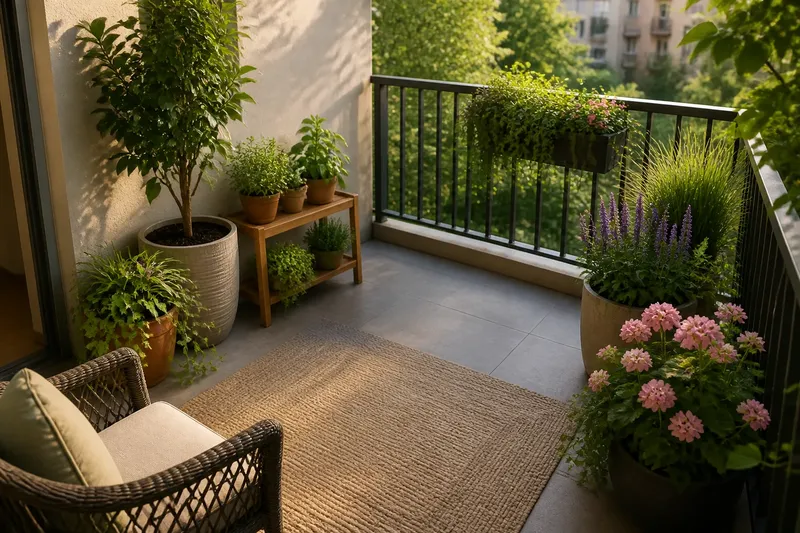
The most common mistake in arranging balcony plants is treating every bare patch as a place for another pot. That can make a small balcony feel crowded: containers compete for attention, foliage blurs together, and the open floor that helps the arrangement breathe disappears. Empty space is not a planting failure; it is part of the layout.
More pots create more visual edges
Each planter adds a boundary: a rim, a block of color, a change in height, and often a shadow. A few pots can make those details feel purposeful. As containers accumulate, the eye has to sort more edges and overlapping leaves before it can settle on anything.
This effect is especially noticeable on a balcony, where the railing, door frame, exterior wall, and neighboring buildings already create a dense visual frame. Filling the remaining floor with pots can leave no quiet area for the eye. The balcony may look crowded even when every container fits physically.
More planting does not automatically create a fuller-looking display. A group of unrelated pot shapes and foliage textures can read as scattered objects rather than a composed garden. The useful question is not how many planters the space can hold, but what each one contributes.
Empty space gives plants room to read
A visible patch of floor or an unoccupied corner acts like a pause between planted areas. It separates leaf shapes, makes a distinctive plant easier to notice, and gives the arrangement a clearer outline. The pause can be narrow or generous; it simply needs to look deliberate rather than like a gap waiting to be filled.
Think of the planting as a composition with a few main notes. One container might carry the strongest form, such as an upright plant beside a wall. Another might soften the edge of the seating area with trailing foliage. An open stretch between them lets each role remain legible.
A lush arrangement can still feel spacious when it has a clear focal point and deliberate gaps around it. Dense foliage and an open layout can coexist.
Give each planter a clear job
Before adding a container, decide what it should do. It might bring color near the door, screen a distracting view, mark the edge of a sitting area, or hold a plant whose shape deserves room. If it does none of these, it may add upkeep and visual noise without improving the scene.
Say you have a small balcony with a large leafy plant, two herb pots, and an unused corner. You consider adding several mixed containers because the corner looks bare. Instead, you leave the corner open and group the herb pots together on a stable plant stand. The observable result is a more defined group of foliage, with the large plant easier to see and some floor still visible.
Try rearranging existing pots before buying anything. Put the most distinctive plant where it can be seen from the doorway or main seat, then group supporting containers nearby. Leave a patch of floor or a section of railing line uninterrupted. Check the arrangement from both the doorway and the seat; a placement that seems balanced from one angle may hide a plant or feel crowded from another.
Use height and grouping without closing the scene
Variation in height can make a planting display feel layered, but too many levels can create a wall of foliage. Use a few clear heights rather than lifting every pot onto a separate stand. A low container, a medium grouping, and one taller focal plant can give the eye a readable sequence while preserving open areas.
Grouping similar pots can reduce visual clutter. Matching or related containers make several plants read as one intentional unit instead of many separate objects. Leave a visible break between that group and the next planted feature; otherwise, the balcony can become a continuous band of pots.
Pay attention to what sits behind the plants. A tall planter against a solid wall may feel settled, while the same object near a railing can interrupt the view and make the edge feel heavier. Keep plants and containers clear of doors, drains, and the areas needed for the balcony’s intended use. For load limits, attachment methods, plant suitability, and local restrictions, follow manufacturer instructions and building rules.
How can you make a small balcony look lush without crowding it?
Should every empty corner have a planter?
No. An empty corner can help the arrangement feel finished by balancing a planted area elsewhere. Add a pot only if it serves a clear purpose and improves the view from a place you use.
How do you make a small balcony look lush without crowding it?
Choose a few plants with distinct forms, then group some together so their foliage reads as one feature. Keep an open patch of floor or wall between that feature and the rest of the balcony.
What should you remove when the arrangement feels busy?
Start with containers that repeat a plant shape, color, or role already present. Move them aside temporarily, then view the balcony from the doorway and seating; keep the arrangement that looks clearer and works better for how you use the space.
Can a balcony still feel full with fewer pots?
Yes. A prominent plant, a compact supporting group, and a distinct open area can create a complete-looking scene without covering every surface. Aim for a balance that lets you appreciate both the plants and the balcony.
Check the layout before adding another pot
Look at the whole balcony rather than the bare spot alone. Use these checks to decide whether to keep the arrangement as it is or change it:
- Check whether the focal plant is visible from the doorway; if it is, keep its position, but if other pots hide it, move the focal plant or regroup the containers.
- Check whether a patch of floor remains visible; if it does, preserve that pause, but if pots cover the usable floor, remove or relocate a container.
- Check whether the plants form a clear group; if their shapes and pots read as one feature, keep the grouping, but if they look scattered, bring related containers together.
- Check whether a new pot would repeat a plant shape or color already present; if it adds a distinct role, consider placing it, but if it duplicates an existing one, leave it out or replace a less useful pot.
- Check whether plants obstruct a door, drain, or the route to your seat; if the route is clear, keep the layout, but if it is blocked, move the containers before adding anything.
- Check whether the railing view feels open; if it does, maintain the gap, but if tall pots interrupt it, shift them toward a wall or choose a lower placement.
If these relationships are already working, resist the urge to fill the remaining gap. Empty space is an active part of balcony plant design: a few well-placed containers can make a space feel leafy and personal, while a visible pause helps it remain comfortable to look at and use. When a balcony feels smaller than it should, regrouping or removing a pot may help more than adding another.