The Open Route: Why Clear Paths Make a Patio Easier to Use
Clear patio paths connect the door, seating, and garden with an easy-to-follow route, helping people reach each area without crossing the center of a gathering.
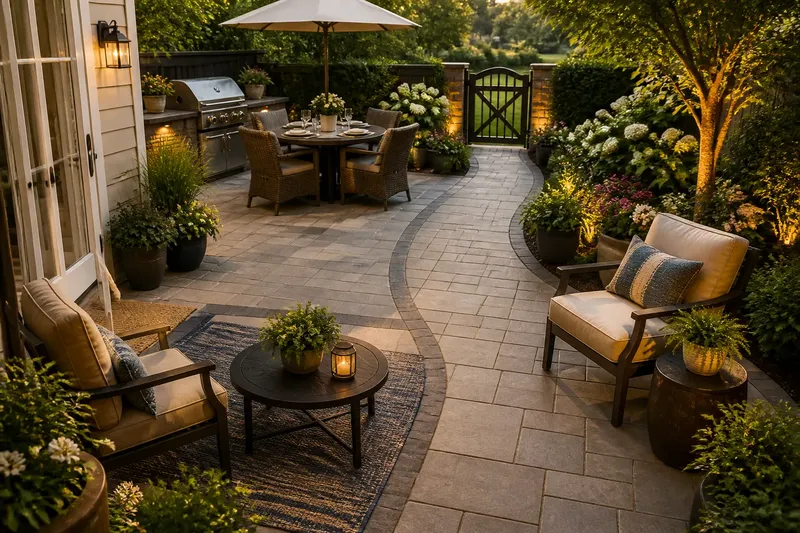
The most common patio-layout mistake is treating the leftover gaps between furniture as paths. That can leave the door blocked, make the garden hard to reach, or send visitors through the middle of a conversation. A clear patio path gives people an obvious way between destinations without making the whole patio feel like a hallway.
Plan the route before settling on furniture positions. Think about where people enter, where they want to go, and which areas should remain places to stop rather than pass through. A quick sketch, painter’s tape, and a walk through the space are enough to reveal problems before they become part of the arrangement.
Map the destinations before drawing a route
Mark the places people need to reach: the back door, steps, gate, grill, dining table, lounge area, and path into the yard. Draw a rough patio outline on paper, or use painter’s tape to mark the footprints of large objects on the surface.
Connect the journeys people are likely to make repeatedly, such as door to table or door to garden. Avoid drawing a line between every possible pair of destinations. Too many routes can create crossings through the center of a seating group.
Use a pencil line on the sketch, or lay a garden hose along the proposed route. Check that someone can glance at the arrangement and see where the route leads. If its direction is unclear, simplify the course before adding furniture.
Make the main patio path easy to follow
Give the busiest connection a continuous course. It may follow the patio’s edge or pass between activity areas, but it should not cut through the center of a conversation space. A broad, simple bend is easier to read than a series of turns around unrelated objects.
Check the arrival and the destination. Someone coming through a doorway should be able to step onto the route without immediately turning around a chair. At the other end, the route should lead to a usable side of a table or seating group rather than stopping behind it.
Keep visual cues consistent. Open paving, a change in surface, or a line of low containers can help show where to walk. Do not place a cluster of pots in the middle of a route that otherwise reads as open space. Position patio lighting so people can see the walking surface without aiming a bright fixture into seated guests’ eyes.
Arrange furniture so destinations remain accessible
Place the largest pieces first. A dining table, sectional, or substantial lounge chair defines an activity zone and is less convenient to move later. Leave room for the way people use those pieces, not just their parked position. A route that looks open beside a tucked-in chair may disappear when someone sits down.
Add side tables, stools, movable chairs, and umbrella bases after the main furniture is settled. Put each smaller item where it serves someone without interrupting a turn or narrowing the apparent route. An umbrella base can take up more floor space than its pole suggests, so check the base itself.
Say a patio has a door at one end, a small dining set in the middle, and two lounge chairs near the garden. Move the chairs to either side of the direct line to the yard and angle them toward one another. The expected result is a visible route to the garden and a connected seating area that does not require visitors to pass between the chairs.
Keep paths outside the places where people gather
Put a route along the edge of a conversation group where the layout allows, leaving the space between seats for conversation. On a compact patio, arranging seats in a shallow arc along one side may preserve a route better than spreading them across the full width.
At a dining table, decide which side people will approach from and how they will reach the seats. If the table blocks the main connection, try rotating it or shifting it toward an edge. The route should not depend on someone pushing chairs back into place every time another person passes.
Edges can clarify where movement belongs. A change in paving or a narrow gravel border can mark the route, provided it does not create a trip point or conceal where the path turns. Keep containers outside the walking line and arrange them as a boundary rather than as a row of obstacles to weave around.
Check the patio path with the layout in use
Stage the patio as people would actually use it. Open the door fully, pull dining chairs out, and put movable pieces where someone might leave them during a visit. Walk the intended route carrying a tray or watering can. Notice where you slow down, turn awkwardly, or would need to move something.
- Door and threshold: Check whether the open door leaves a clear entry. If it does, keep the approach; if not, move the nearest chair or table and try the entry again.
- Route direction: Check whether the next destination is visible from the entry. If it is, retain the course; if not, shift a visual obstruction or simplify the bend.
- Turns: Check whether a pot, umbrella base, or table corner interrupts a turn. If it does, relocate that object; otherwise, keep the turn as laid out.
- Seating in use: Pull the chairs into their usual positions and check whether the route remains open. If not, move the seating group or choose a different route; if it does, keep the arrangement.
- Gathering areas: Check whether someone walking through would cross the center of a meal or conversation. If so, reroute along the group’s edge; if not, retain the connection.
- Surface transitions: Check whether a rug edge, threshold, or paving change makes the route hard to follow. If it does, reposition the rug or clarify the route with open space; if not, leave the surface as it is.
- After dark: Switch on the patio lights and check whether the walking surface and turns are visible from the door. If they are not, adjust the fixture or add light at the unclear point; if they are, keep the lighting arrangement.
When a check reveals a blockage, move the object causing it rather than making a string of tiny changes that leave the route confusing. If the patio cannot support a direct line, choose one broad, readable curve and let the furniture placement reinforce it.
What do people ask about a clear patio path?
Should a patio path run through the center?
Not by default. A central route can divide a seating area or pass through the middle of a meal, so an edge route may suit the layout better. Choose the course that connects the places people use while leaving gathering areas intact.
Can a patio path curve around furniture?
Yes, if the bend is broad and its direction remains obvious. Avoid a string of turns that sends people between unrelated objects. If you cannot point out the route quickly on a sketch, simplify it.
How can a small patio keep a clear path?
Use fewer pieces and make the most-used connection part of the fixed layout. Narrow or movable furniture can help, but the route should not depend on someone shifting a chair every time they pass. Let less-used destinations share part of the main route.
Can planters mark a patio path?
Yes, when they sit outside the walking line and do not hide a turn. A consistent line of containers can clarify an edge, while scattered pots can make the route look interrupted. If a planter makes the way forward unclear, move it rather than asking people to weave around it.
Use a worked layout to decide what to move
Imagine a patio with a back door, a table between the door and the yard, and two lounge chairs near the gate. For this invented example, assume the open space is tight enough that a direct line from the door to the gate would cross the table’s main seating side. First, draw the door, table, chairs, and gate on paper. Next, mark a route that follows the patio edge, then shift the lounge chairs to the far side of that line and turn the table so its approach side faces the door. Finally, open the door and pull the table chairs out to represent an ordinary meal.
If the staged arrangement leaves the edge route visible and lets people reach the table without crossing the lounge chairs, keep that layout. If a pulled-out dining chair blocks the route, move the table closer to the opposite edge and repeat the walk-through. The resulting decision is based on the actual obstruction: retain the arrangement when the route stays clear, or reposition the table when it does not.
Keep the main connection recognizable as use changes
An extra chair, a grill in use, or an open door can change how people move across a patio. Recheck the main route after a meaningful change in furniture or activity. If the new setup hides the route or sends people through a gathering area, adjust the layout instead of relying on visitors to invent another way through.
A clear patio path can pass beside a favorite chair or follow a border of pavers without looking bare. The useful test is whether someone can identify the next destination and reach it without shifting furniture or interrupting a group. Keep that test in mind as you arrange the space, and the route will remain legible as the patio changes.